Tuesday, March 7, 2017

MidAmerican Wind property tax


Anyone living in Iowa is probably aware that the states budget is in dismal shape, forcing legislators to make some very unpopular funding cuts. Maybe state officials should look into MidAmerican's wind property tax filings to see if they have missed some additional revenue.    

There are numerous posts on this blog that cover my concern that the utility's wind project assets may be undervalued. This update lists a few exanples where the utility's county wind property tax filings simply don't match their press releases, their Federal filings at FERC, or their Iowa Utilities board filings. Every one of their county filings I've reviewed so far, lists lower project values than the utility reported for the same project elsewhere. This story plays out in three parts:

1 - Reported project costs.    

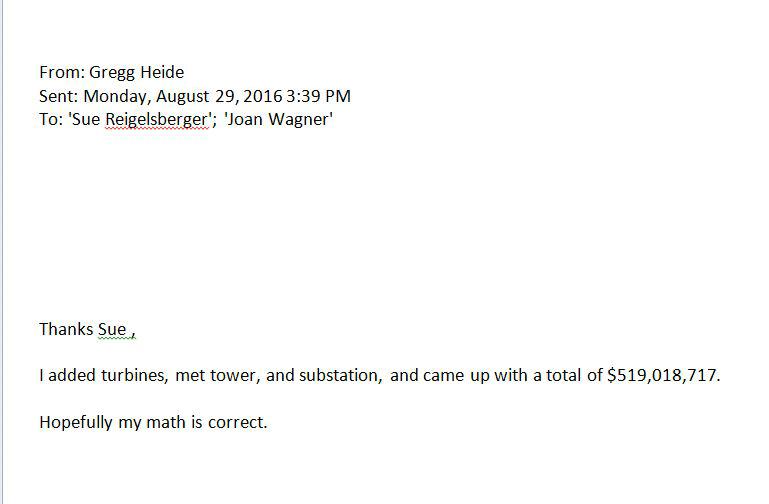
First, let's look at the MEC Lundgren project in Webster County. This press release  found online provides the cost of wind VIII, which Lundgren is a part of .This cost , divided by the number of wind turbines in wind VIII, results  in almost $80,000,000 higher costs than the Utility filed for property valuations in Webster county
Some of the $1.9 billion will be substation and grid upgrades, but since those are valued in Webster county at about $12 million, the numbers clearly are a long way from balancing.
These wind projects will  on the tax roles for years , and if several million dollars are missing each year…   

It is interesting to note that the $80,000,000 higher number actually is closer to what the Iowa Wind Energy Association estimates the cost ofinstalling wind energy to be.


$1.9 billion divided by 448 total turbines = a value of $4,241,071 per turbine. The utility reported a value of $3,493,871 for each turbine to Webster County.


MidAmerican also reported a higher cost to the Federal Energy Regulatory Commission than they listed on their Webster County valuations, though the values are about $5 million higher here.


The other MEC wind project example is the Pomeroy project , located in Pocahontas and Calhoun counties . I went to the Calhoun county property tax review board  with this concern, and was rejected, but in the rejection letter  , the Assessor actually provided information that showed I was correct.


The board dismissed my "protest"  "due to lack of standing". Interestingly, In her letter announcing the review boards decision, The assessor mentions she contacted the Iowa Utilities Board (IUB), and that the final installed cost of MidAmerican's wind project in the county was  $1611 per kw.

The wind industry frequently refers to cost figures in $ per kw . In this
case, the turbines are 2.3 megawatt turbines, or 2300 kilowatts.   $1611 x
2300 = $ 3,705,300. MidAmerican's property tax filing to the county was
$3,631,990 total acquisition cost per turbine, a difference, of $73,310 per turbine. So the assessor is basically telling me I was right, but dismissing my claim anyway.

$73,310 x the 184 total number of wind turbines in this project comes to $13,489,040 , and actually the utility Reported about a $15,000,000 higher project cost at the federal agency than  they reported to the county. Definitely closer the utility's federal filing than its county valuation.    


Here are the county values.  (email with county assessors for Pocahontas and Calhoun counties). This project has been in operation almost 10 years, so we have the possibility that about $150,000,000 hasn’t been taxed.
Plus, MidAmerican has 20 plus wind projects, and I’m seeing these same discrepancies in every one  I’ve looked at so far.


2- The Utility is listing some wind assets in the Iowa Utility replacement tax instead of reporting them as wind assets under Iowa Code 427B.

In a call with the Iowa Department of Revenue, the staff I discussed this with maintained that this was not happening, even after after I emailed them the following information, which leads me to the conclusion that MidAmerican likely made this decision on their own.

More than likely , this lowers the tax rates on those assets, affecting local government and schools. Neither DOR or local government has assisted identifying these assets in the utility replacement tax filings yet, I can compare the assets current tax rate ,  to what the assets would be taxed as if classified as 427.B wind assets.

Also, it seems unfair , as I don’t think a non-utility owned wind project could use the replacement tax. Below, is an example of this from the Lundgren wind project in Webster county.  
I also have an archived email from a MidAmerican employee stating this was done at the Pomeroy project location, so most likely at all their 20 plus wind project locations.

After visiting with DOR about this, I couldn’t help but wonder if MidAmerican is self-reporting  all their replacement tax filings as well , and what , if any , methods DOR uses to verify those filings.

 
MidAmerican filed this document in Webster county:


The utility later filed this document, stating the above substation was being transferred to replacement tax area.


Here is an aerial view of the 2 wind energy substations. The lower substation is the item discussed in the filings.  The filings above indicate  that both were constructed to connect the wind farm to the grid.
Certainly wind related assets appear to be included in the lower station.  This is one instance of wind property in the replacement tax system.


3 - Iowa Department of Revenue's Property tax division gives clear instructions to county assessors for valuing wind project assets. County assessors don't appear to be following those instructions on the MidAmerican projects I've reviewed. 


This  2010 Department of Revenue mail to county assessors, directs them to be sure all wind plant costs are accounted for.


I met with the Department Of Revenue in 2014, after which , their legal department sent me the memo below which pretty well confirms the 2010 directive above . There are several answers to questions from county assessors here that also support these documents


Yet, Assessors don’t seem to be doing this. The email below from the Pocahontas County assessor to a wind developer states that usually she receives a simple cost per turbine  letter form the wind project. The developer below did provide very detailed cost information that supported their property tax filing .  The MidAmerican filings I’ve reviewed often have no supporting documentation, definitely not as well documented as the Gamaesa  project below.  The Gamesa project also appeared to have a higher cost per installed kilowatt (again closer in line to IWEA's estimates)  than the Midamerican project in the same county .


The below email from the Calhoun County assessor states that every county with wind property is assessing the same way.  
So, the Department of Revenue gives clear directives how wind property should be assessed, but county assessors aren’t doing it in my opinion. 


I’ve sent quite a bit of info to the Iowa Department of Revenue and Department of Management, in addition to county assessors in Webster, Calhoun, and Pocahontas counties, so it will be interesting to see what develops.  


here


Wednesday, August 10, 2016

Heat Pump Clothes Dryers


Our 1970s era clothes dryer is a bit more noisy than it should be. It is pretty easy and usually low cost to repair. My area appliance store has a number of these machines in service yet, but, I've been researching  heat pump dry clothes dryers back before they were available in the U.S. Now, they're here and it might be time to upgrade.  It was harder to justify buying a new dryer when the replacement would consume just as much electricity as the old unit and repairing our current one was more cost effective than purchasing a replacement. 

My rural electric coop doesn't have much info about heat pump dryers, but about 3 years ago, I found a link from their national association that wasn't very kind to the new tech. The title -
"On the Way: A $2,000 Clothes Dryer"  was kind of the first clue they would rather you stayed with the  higher KWH consuming dryer, though in the article, a price point of $1000 to $2000 was mentioned. Looks like the title price was off a bit. 


After listing many good features, lower energy costs, no outside venting, so lower fire risk,and  lower environmental impacts, the REC  program manager then noted “If you have a large family, no way in the world can you get a device that takes twice as long to dry your clothes.”. He concluded by suggesting that members who wanted to save money should hang their clothes outside to dry. Given this curmudgeon like advice, It was refreshing to see the new found love for energy star dryers (including heat pumps) from the RECs in my latest coop newsletter


Who knows, maybe the REC's can also change the "get off my lawn!" attitude they display towards members who want to generate their own electricity, because a lot of them will want to do just that!   


 As for dryers, since we haven't purchased one yet, here's a gentleman who has been living with a heat pump dryer for a while, and he's put much more info together than any of the utility programs I've been able to find

About the only items I would add. to his excellent blog post, is that retail electric rates will probably continue to rise over the life of this appliance. Also, many consumers will be replacing dryers with much less drying capacity than the new dryer, resulting in many less dryer loads annually . Given these items, consumers might see slightly improved economics than listed .   


Tuesday, August 2, 2016

Renewable Energy And National Security


Renewable advocates and climate hawks over the last few years have claimed that wind and solar play a crucial role in national security.  The above photo shows a t shirt of mine purchased at an Iowa renewables conference a few years back. Lately, it seems that advocates have steered away from this message to instead directly discuss co2 reductions. This may be because the United States has built renewables to date mainly, using the same large scale centralized power station model favored by the fossil fuel and nuclear industry.The country also currently has ample supplies of fracked national gas, coal, nuclear power, etc., so the national security advocating seems to have faded with greens and climate hawks, if they ever truly believed the security benefits position in the first place. It may have been a tactic to attract support from non traditional interest groups.  But, the security message is also invoked by non renewable interests, so...   These days, there seems to be a renewed (pun intended) push for regional transmission and even global grid networks to encourage renewable energy. I’m still amazed when the “large scale renewables is the only way” advocates start to hyperventilate when trying to understand why rural residents push back against absentee owned transmission lines and large scale renewable projects, , the ventilating continues when voters fail to prioritize clean energy at election time. Most voters support clean energy, but I've yet to see a poll where energy, clean or dirty, ranks high in the voting booth.  But, I digress.

 It’s pretty hard to square the security narrative with large scale renewable power plants IMHO. We have plenty of resources, clean or otherwise. When security comes into the dialog, we must take another look at how we build power plants and design the grid, and whether our resources will provide electricity to our homes and businesses when things go wrong.  

The hard truth is little to none of these resources will be available if we have a grid outage. In that case, it will be difficult to transfer coal and natural gas to power plants,and nuclear has demonstrated problems with shutdowns and restarts (search the net for Fukushima).  So, renewable energy produced on site becomes very important, along with a distributed localized grid.  None of the large scale wind or solar farms-will be of any use to us if the grid has a major failure, due to weather, cyber-attack or low tech malice, fire, by physical damage or shorting out the grid when smoke accumulation causes power lines to arc to the ground, ice storms, or even critters. If we have any kind of sizable grid outage, we’ll have national security issues. So let’s look at some of the things that can go wrong. 

A raccoon recently caused a power outage for about 40,000 Seattle folks. This internet search also provided a link to a rather tongue and cheek looking website bragging about all the grid attacks undertaken by squirrels, (Hmm, quite a few in Iowa) greatly out numbering cyber-attacks.

Anyone following the news though, can’t help but notice the amount of cyber hacking lately.  Cyber-attacks are happening to our countries infrastructure, and most likely will continue for the foreseeable future.  A recent attack against the grid in Ukraine should be a wake up call for all of us. Check out this fascinating article  - 

“the control systems in Ukraine were surprisingly more secure than some in the US, since they were well-segmented from the control center business networks with robust firewalls. But in the end they still weren’t secure enough—workers logging remotely into the SCADA network, the Supervisory Control and Data Acquisition network that controlled the grid, weren’t required to use two-factor authentication, which allowed the attackers to hijack their credentials and gain crucial access to systems that controlled the breakers”

Yes folks, we’re behind here, but not just in that respect- 

 The power wasn’t out long in Ukraine: just one to six hours for all the areas hit. But more than two months after the attack, the control centers are still not fully operational, according to a recent US report. Ukrainian and US computer security experts involved in the investigation say the attackers overwrote firmware on critical devices at 16 of the substations, leaving them unresponsive to any remote commands from operators. The power is on, but workers still have to control the breakers manually.

That’s actually a better outcome than what might occur in the US, experts say, since many power grid control systems here don’t have manual backup functionality, which means that if attackers were to sabotage automated systems here, it could be much harder for workers to restore power.”

This does seem to be on some government agencies and policy maker’s radar, but so far, actions seem to be concentrated on beefing up the current centralized system and shortening the repair time. However, given the challenges here, I have felt for quite a while that this can only be a short term strategy.  In the following link,  the recently retired head of FERC, Jon Wellinghoff, shares this belief. I’d encourage folks to read this in detail,  Some quotes of interest here- 

“I think we are in a very tenuous security situation, mainly because of the way the grid is configured.  It is currently set up in such a way that requires central station generation, which is then distributed through nodes of high voltage substations and then sent out to load centers. This centralized distribution system presents an array of vulnerabilities from a cyber and physical security standpoint.”

“A node is one of a number of high-voltage substations, which are contained within the three main interconnects making up the North American power grid; the Texas, Eastern and Western interconnects. The nodes are sort of a gathering point inside the interconnects where more than one power generation source feeds into, which is then distributed out to load centers. These particular nodes, if they are knocked out by either a physical or a cyber-attack, could have a major destabilizing effect on the entire grid system. Repairing these nodes has a long lead time due to their highly customized designs. So if there are multiple node outages it could be many weeks or months till the system is back to normal. By then, the country could be in chaos.”

There was also a link in this Q and A session to a previous chat with former Clinton era CIA head James Woolsey that went into great detail about the potential “chaos”.  

The EMP Commission, which was set up after 9/11, estimated that within 12 months of an EMP event, two-thirds of the US population would likely perish from starvation, disease and societal breakdown. Other experts estimate the likely loss to be closer to 90 percent.

Q. Really? That bad?

A. Oh, sure. William Forstchen’s novel, One Second After, gives a chilling portrayal of what life may look like after an EMP detonation. It describes a population totally unsuited for living in the dark. Deaths come in waves; first the elderly and then those who depend on medication. Following that are those who die of simple diseases, like typhoid or dysentery, as well as those who have no survival or farming skills, though even subsistence farming would likely be a challenge given the speed in which society would collapse versus the time it takes to actually prepare fields and grow substantial amounts of food. Eventually, the few survivors in the small town who have overcome these deprivations and learned to produce food face continual security issues, having to fight off marauding bands and, interestingly, bullets become a base currency in their economy. It’s pretty bad stuff.”

Sounds more like a crap storm than “chaos”, but let’s go back to Wellinghoff - The solution is to go small and distributed, not big and centralized.

“Well, there is only so much you can do. We could physically protect these nodes by beefing up security around them, but they’ll never be totally safe from a physical or cyber attack. It is sort of like building a firewall to keep out hackers. Eventually, the hackers will figure out how to get through, forcing you to build a higher firewall. It never ends. What we need to do is to move forward from this kind of thinking.”

“We need change the way the grid works, not just build higher and higher walls around these nodes. This can be done by shifting from a centralized to a distributed grid architecture in which power generation is dispersed along the grid.” 

Despite the fact that Wellinghoff was extremely noisy about this during his time at FERC, precious little happened during the current administration, due to push back from incumbent utilities (you know, the companies making the money off of our century old grid design) and the makeup of the current regulatory system. I wasn’t surprised when Mr. Wellinghoff mentioned in the article that he was looking into adding a battery backup system to the solar array installed on his house. Hey, if a head of FERC is this concerned, maybe the rest of us should be also. We should be going smaller and more local with grid design, not bigger and more centralized. That means less big transmission lines and more microgrids. We certainly shouldn’t be trying to do both at the same time.

So this country needs a robust distributed generation policy, which almost none of our elected or regulatory folks are talking about. One of the few places giving serious discussion to changing grid design is New York State, after Hurricane Sandy pointed out the flaws of their centralized grid design. It’s time that Iowa and the Midwest did the same. Wellinghoff said it well -

"How quickly we get to a distributed grid depends on how quickly we recognize the value of moving there."

I’ll throw the transmission line advocates a bone and agree that some new power lines are probably needed in the U.S. But, a national distributed generation policy would make it much more clear where those builds should take place.

I’d also be remiss here if I didn’t mention other side benefits to going local and distributed with grid design-
Democratization of energy production, the folks at ISLR are great at covering this.
More public support for the climate hawks desire for co2 reductions. Who knows, people might even think more about it when voting. November is coming, advocates!
Energy dollars stay in local economies, instead of billionaire’s pockets.
Local renewable owners might engage more on other environmental issues.

Thanks for stopping by.

No problem can be solved from the same level of consciousness that created it.
Albert Einstein


Edit, Sure enough, something happened today Aug 8, that is relevent to this topic. I'll just put this right here


Edit 2 There's a lot of info on the web about this issue. Including a recent article in my REC magazine reassuring members they are on top of this, and speculating the Ukraine outage happening in the states is unlikely , since it was "low tech". 


Plenty of other folks are worried about low and high tech attacks on the grid, however. Here's a couple more articles.  


Monday, May 23, 2016

Why Iowa Is Leading In Wind Power


It’s no secret that Iowa is a leader in wind power. News outlets, internet searches, wind trade organizations, etc. all tout Iowa’s installed wind capacity, though I’ve yet to see an article that explains why Iowa has become a wind power leader.
The quick answer is - Policy!   

Iowa’s first wind construction of note happened because the state's legislators required investor owned utilities to have 2% wind in their portfolios. Utilities opposed the legislation, though it passed and required utilities to purchase wind energy from other sources. Legislators envisioned lots of small installations, owned by farmers and other entrepreneurs, but ended up with a single installation owned by Enron (sigh). 


Wind was also added in the windier parts of northern Iowa to support RPS goals in surrounding states (looking for a supporting link here).  Iowa also has a special wind property taxassessment, and access to the sometimes available, sometimes not, federal windproduction tax credit. However, none of these policy tools catapulted Iowa to leadership status IMHO. 

Faced with a potential increase in the states renewable portfolio standard in 2003, MidAmerican instead pushed legislation passed by the Republican controlled House and Senate, and signed by then Governor Tom Vilsack, that allowed MidAmerican to include wind generation in its customer rate base. That’s right, Iowa didn’t lead in wind energy until one of our large utilities was guaranteed a minimum rate of return on its wind assets (kind of sounds a lot like a feed in tariff, right?)  That legislation also conveniently (for the utility) excluded farmers and other independents from receiving the same fair treatment.  A proposed amendment to the MidAmerican bill to fix that omission failed. And, MidAmerican still fiercely opposes any legislation to level the playing field. Iowa’s relatively small distributed wind, farmer and independently owned assets since, have been constructed using a hodgepodge of state and federal grants, tax credits, and other incentives, often at considerable risk.  

Wind is very cost competitive with other generation sources of course, though MidAmerican’s owner Warren Buffet would tell you otherwise. So, Iowa policy makers, how about a stable fair policy that gets renewable energy for the rest of us

Edit - part 2

Since we set the "way back machine" to Iowa's early wind power days and Enron, I should note that Iowa policy makers anticipated then that electric utilities in the state would become deregulated. In fact, the states investor owned utilities pushed heavily for it in 2000. In 1998, Utility property tax rates were overhauled anticipating such a change, creating a utility replacement tax. The deregulation effort was halted here, probably when the Enron scandal broke, and also I hear, because of heavy resistance from the state rural electric coops, labor, and the enviro community. I'm guessing at least one of those groups regrets that decision now. 

However, my understanding of the wind bill put forth by MidAmerican is that it achieved partial deregulation, deregulating the wholesale market, allowing the utility to build excess wind capacity,and guaranteeing a rate of return, while also shutting out competition. Customer rate payers were held captive to their monopoly utility, unable to shop for competitive electric plans, and receiving unfair treatment if they wished to generate their own electricity. Partial deregulation allowed the Enron market manipulation scandal to happen in California, though differences in Iowa's legislation seem to be more about limiting competition and limiting consumer choice.  

So, this stinker policy change is responsible for Iowa's "leadership" in wind energy.
Even though legislators originally envisioned diverse widespread ownership of renewables in Iowa, one utility has cornered the market. 

MidAmerican - stable, guaranteed rate of return on wind assets, while only required to offer low avoided cost to farmers and competitors, 

Profits flow to Berkshire Hathaway instead of being retained in rural Iowa.

Ratepayers left without choice in electric providers.

and etc. 

Bad as this legislation is, it still proves that only a stable risk free environment will allow for this country's transition to clean energy. Distributed generation is an important part of that transition, but now utilities are moving to corner that opportunity as well. Distributed generation needs such a stable policy as well, except one that creates opportunities for farmers, home owners, and other average folks, not big utilities. In other words, it will be much easier to get public support for said clean energy transition, if we create policy that benefits the many, not the few.  In Iowa and nationwide, its time for energy democracy