Sunday, September 23, 2018

MidAmerican wind property tax update


This post contains a number of emails sent to the Iowa Department of Revenue in 2016, documenting a number of discrepancies regarding MidAmerican's wind property tax filings. This first email was also sent to the sent to the Calhoun and Pocahontas county assessors, Chris Vrba at the Pocahontas county Record Democrat, as well as a number of other folks. The other emails were forwarded to a number of folks as well.
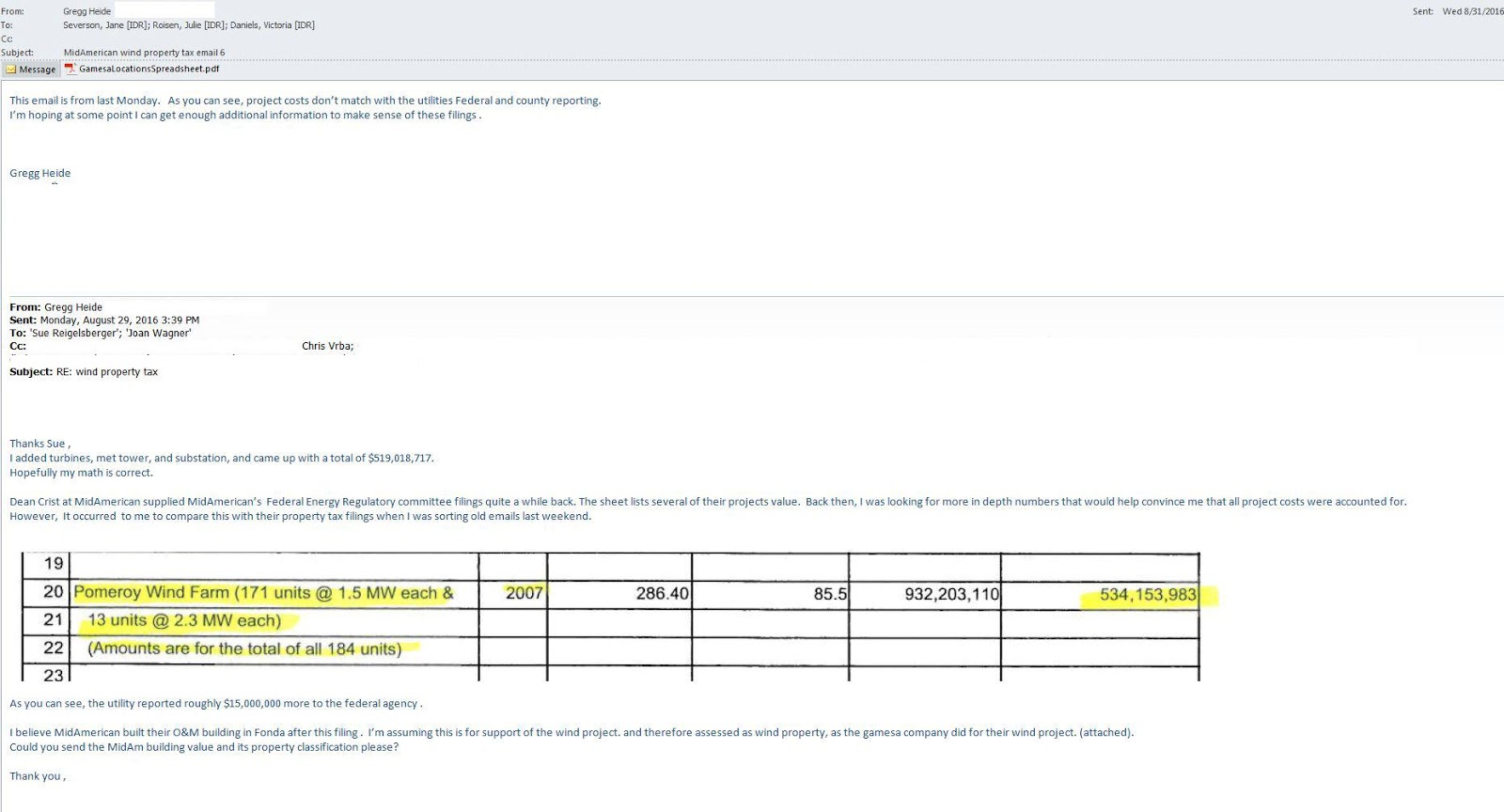


   MEC reported to FERC that the Pomeroy wind project had a higher installed cost than the utility reported to the Pocahontas and Calhoun county assessors.


The Iowa code directs wind project owners to report installed costs to county assessors after the project is placed in service. The state department of revenue has also published memos to assessors direct them to verify that all hard and soft costs are accounted for. All the assessors I've checked so far are letting the wind project owners self report and are not ensuring all project costs are accounted for . In fact I've heard an assessor state in a public meeting that she was warned not to contest wind project valuations by the state DOR. I've asked the state DOR to clarify this back in 2014, and received a letter stating assessors should account for all costs. it's not happening yet.  


After the state DOR directed me to seek a remedy to wind property concerns through the local property tax review board, I notified the state DOR that didn't receive a fair ruling at the Calhoun county property tax review board.


I notified the state DOR that MEC was declaring some wind property in another tax program.


A wind Project in Carroll county reported an installed cost for the same type of wind turbines used by MEC at some of their wind projects at more than $ 1 million higher per turbine than MEC. I would expect some turbine cost savings when buying them in large numbers, but not $1 million per turbine. Assessors or auditors should examine the MEC turbine supply agreements with the turbine manufacturer. they're available at the Iowa Utilities Board if MEC won't provide them.   


So, what was the state DOR response ? no reply...crickets chirping.... but, they definitely received them


So, after hearing nothing back from the department of revenue, I reached out to the department of management, who oversee the state budget. The department of management reached out to the department of revenue.  I then received an angry call from the DOR property tax department, which I wrote about here.      
DOR called me rather than go on the record. My memory of that call ... first , it seemed like they thought I didn't know what I was talking about... then they must of decided I wasn't full of it and the conversation shifted , and they said they weren't going to devote resources to this issue,... and they defiantly wanted to know who at the Iowa utilities board provided some of the information we discussed. The caller was angry, but I guess the flak only gets heavy when you're over the target.
DoR is welcome to respond to the list of questions I sent them in 2017.

So does the utility have too much influence at the state level to look into this? I hope not.
When you visit the DOR website  you can find the following info.

 Property tax division - mission statement- and it looks like they want to know if the state isn't getting all the revenue it's due. 


After the the angry call I received for the state DOR, the state Department of management ceased responding to this issue as well. If you look at their mission, you'd think they would be somewhat concerned about the items I've found.


    So why are so many people pushing back against or ignoring this issue. Maybe this post sheds some light on that .


here

Sunday, September 9, 2018

MidAmerican wind property taxes update

There's some news again on the MidAmerican wind turbine re power plan. people in the area are rightly concerned that counties may not receive any additional property tax revenue as a result of this large improvement.

First, I think it's useful to recap some of the MEC wind property tax information I uploaded to the blog over the last several months, and see how it is related to the current re power issue. I'd recommend that interested readers first review my previous post for some additional insight.

I contacted my district state senator, Daryl Beall, in 2014 about my concerns with MidAmerican wind project valuations being too low . Senator Beall promptly scheduled a meeting with Julie Roisen at the department of revenue property tax division . Mr. Beall was unable to attend so a senate staff person and myself  attended the meeting together. We met with Ms.. Roisen  and a staff person. I got the distinct impression that the department of revenue thought I was wasting their time at this meeting. It was explained to me that wind property was locally assessed, and that DOR only issued advice on how to perform that task. If I was worried about wind property valuations, I was directed by DOR to use the local property tax review board, and DOR explained that process along with the state appeal process. They also provided me with a letter from their legal adviser, that seemed to once again direct county assessors to fully account for all wind project costs. It is posted on this blog.
Afterwards, I wrote a thank you letter which recapped my understanding of what was discussed at the meeting. DOR has never disagreed. I've since updated the undervaluation number in the email to $150 million , and MidAmerican now has more than 20 wind projects. I also sent additional  information to DOR in 2016,and hearing nothing back reached out to the Department of Management in 2017.  DOR called me soon after that, stating they were not going to devote resources to this issue, but mainly, it amounted to chewing me out for a half an hour. Here's the 2014 DOR email.   


I then followed DOR advice and asked the  Calhoun county property tax review board to look into my concerns the MidAmerican's wind property was undervalued . I met with the review board. Later, the Calhoun assessor sent a letter that denied my "protest" , but included information that basically said I was right. That information is here.

So to recap,
Every MidAmerican wind project I've checked so far shows lower valuations at the county level than MEC has stated at the federal level, in MEC press releases, and some information I was able to review at the Iowa utilities board.

MEC is placing property in the Iowa utility replacement tax that meets the definition of wind property when the wind code is reviewed IMO. DOR says that is not happening. I've got an email from a MidAmerican employee that says it is. Pocahontas county has 2 large wind projects. The one not owned by MEC declared similar property to the MEC replacement tax items as wind property.

The replacement tax issues leads to a much bigger concern. state officials and local officials had not noticed the replacement tax problem, and I've found an example of MEC wind property that was never added to replacement tax rolls as MEC has stated. Since Iowa utilities pay most of their state taxes through the replacement tax system... Well.... MEC replacement tax  filings need a proper audit IMO, probably several years worth.


So there is some precedent to resolving wind property valuations locally, That's what I was told to do. For the folks currently worried about the wind re power issue, I'd recommend they try to resolve this locally.  However, the Pocahontas record Democrat reports that after noting it may be some time before the state AG office looked into the wind re power issue, AG promptly replied, and encouraged  BV and Pocahontas county to request a formal opinion on this issue from. DOR.
State AG also mentioned using the existing local property tax review and appeal process. I haven't seen the AG letter. Hopefully I can get a copy.

I noted in the previous post that I was concerned about a potential state AG office conflict of interest. Now the AG has referred this matter to the department that so far is declining to look into potential lost revenue that I've listed on this blog, and who has already wrote an opinion unfavorable to counties on the re power issue.

The counties should try to solve this locally before ceding their authority to the state level, and risking an unfavorable ruling. Whatever the outcome, county assessors seem to think they can't assess wind property unless the wind project owners do it for them.. even though a lot of DOR memos seem to say otherwise. It concerns me  when all this is said and done, that MEC will still self report their wind valuations to county assessors, when I've listed a number of examples that seem to point out that MEC shouldn't be allowed to do that. A Webster county supervisor mentioned they sometimes retain 3rd party consultants to make sure industrial  property tax filings are accurate, seems like that would work for wind property. More precedent for resolving this locally IMO.  And if MEC is self reporting their replacement tax filings, that shouldn't be allowed either  


I'll be uploading the emails that I sent to DOR on this issue soon.


here


Wednesday, August 29, 2018

MidAmerican Wind Repower

MidAmerican is re powering wind turbines at numerous sites in Iowa.  I've written numerous posts here asking why MEC property tax filings to county assessors. are lower than the utility has reported elsewhere, including FERC, the IUB,and in their own press releases.

I also threw in my 2 cents about the re power back in May , after voicing concerns at a Feb. zoning meeting in Pocahontas county concerning an MEC planned re power there. Not only do the current property valuations appear too low on this project, as I've noted in this post, but county officials have explained there will be no property tax increase as a result of the re power improvement. I asked the county to request that the property tax discrepancies I've found on this project be resolved before permitting was approved. That might not be traditionally germane to the permitting process, but I certainly thought it was reasonable to ask. Especially now that a major improvement was planned with no tax benefit. The county declined to do that.

MEC changed their re power plans for this project , apparently now MEC also intends to re power  turbines installed in 2011 as well , despite telling the IUB that properly maintained wind turbines can generate electricity for 25 years or more. This change required MEC to modify their permit application , and another zoning meeting was held on August 13. I attended  this meeting as well, and repeated my Feb concerns about the wind projects tax valuations , including noting the re power should be treated as an improvement.  The county again approved the project without cleaning up the tax issues.

Several MEC employees were in attendance and one of them agreed to get me information I requested the county officials to look into. It was Adam Jablonski, and he did call a couple days later, leaving a voicemail stating he was hoping to discuss this to make sure he understood my concerns-better understand them ... something to that effect, and that he would be setting up a call with the MEC tax department. . My call back went to voicemail as well, I left my email address, noted I had a small list questions, and that I thought it would be more efficient for all to sort things out by email. I'm still waiting several weeks later.!       

I hear the re power with no additional tax revenue issue getting some discussion in the area, so it was nice to see it addressed in the Pocahontas Record Democrat by Chis Vrba. Chris noted a cost estimate for the re power at this site of $256 million. The article also noted a BV county area attorney had contacted the state AG office in April asking for a ruling if the improvements at wind projects in Buena Vista and Pocahontas counties should be taxed as such. the article also noted a familiar line from 2 county assessors stating they can't raise taxes unless the wind projects report the costs to them. The article is not available online, but I'll add it if I get permission. Chris and the people quoted in the article are welcome to provide a statement as well. Let's look at these three items I noted from this article.I'd also encourage interested folks to pick up a copy or subscribe to the paper.


First, the $256 Million re power.
            

$256 million is a lot of upgrade …it’s not a repair .What are the cost of the new components compared to the old?


I've previously noted  the following issues at this project.

MEC listed a higher cost at IUB and federally … about $15 Million, for this project

Wind project operational for 10 years , so $150 million currently not taxed now.  


MEC has wind assets   in the replacement tax (the wrong Program)  instead of listing them as  wind property.Another wind project in the county lists the same equipment as wind property.

Webster county example of this listed the equipment at about  $3 million,  so $30 million has been improperly tax taxed for 10 years in Pocahontas, If it’s taxed at all . I find no record of this asset added to the replacement tax assets in Webster county.
So the items I’ve found are nearly as large a $$$ amount  as the re power.
Yes folks ,  almost a half $billion dollars not taxed or improperly taxed. MEC has over 20 more wind projects I believe, and I'm seeing theses same issues at other projects.

Next, asking the state AG office for a ruling on this. 

The office of consumer advocate is part of the AG office, and it seems they would be naturally be concerned that any increase in local wind property taxes would cause MEC to ask for a electric customer rate increase, and oppose a property tax increase. In fact, I've had a public official tell me that OCA would likely do just that.
I'm not an attorney, so the gentlemen that asked the AG office for an opinion may very well have considered that. The AG office might also have guidelines in place for when such situations arise. Never the less, it looks like a potential conflict of interest IMO. And the AG office took several months to get back to the area inquiry stating they weren't sure when they would look into this.  I would think a statement from the AG office describing the various AG office responsibilities here would have been included in any reply. 
At any rate, AG joins the state department of revenue, department of management, Iowa utilities board, local assessors, and numerous public officials in being not helpful with sorting this out so far...


And finally, the BV county and Pocahontas county assessors stating they can't increase wind property taxes unless the utility reports the costs.
 I've read numerous department of revenue memos,  directing assessors to account for all wind project costs, and I've listed enough examples on this blog to determine that in my opinion, that's not happening , I see nothing in the wind statute that prevents them from tracing down these discrepancies, or increasing property taxes as a result of the re power. Assessors are welcome to go on record here, or provide the specific part of the code that prevents them from doing this. I'll also note that the Calhoun county assessor verbally told me that all county assessors are using the same methods to value wind property as Buena Vista county, as that county had one of the first  large wind projects in the state. An email from her stating that all counties are assessing wind properties the same way is posted on this blog .

Wind property is assessed locally, and this is a departure from how assessors treat other property owners who make improvements , and, a clear county and state appeal process exists for property owners who disagree with property assessments. In fact Calhoun county has already handled a contested wind property review, and ruled improperly in my opinion.  

So the property tax issues I've been reporting have become an even bigger mess. 
stay tuned. 

here


Thursday, July 5, 2018

Does Midamerican Have Too Much Influence On Regulators and Elected officials ?


IMO ...yes.
Let's look at the actual legislation from the previous post that caused MEC to freak out. Most times, When powerful interests don't like certain legislative efforts, they use their influence to make sure bills never make it out of committee. That way lobbyists who register their declarations on bills, can declare they are undecided on an issue, even though they may be working quietly to kill a bill before it passes out of a committee. In this case, however, The CBED wind energy bill had a lot of support, cause who doesn't like rural economic development?! Back in 2003, I think, Legislators had mainly given control of wind energy in Iowa to the utilities. A number of elected officials were starting to think they wanted locally owned wind projects in Iowa as well. That was why this legislative effort had 31 out of 50 state senators as cosponsors, including then Senate leader Mike Gronstal. This bill sailed out of committee and was quickly scheduled for a senate floor vote.  

            
Now lobbyists had to actually declare what they thought of the legislation. 
Let's look at some of the declarations.


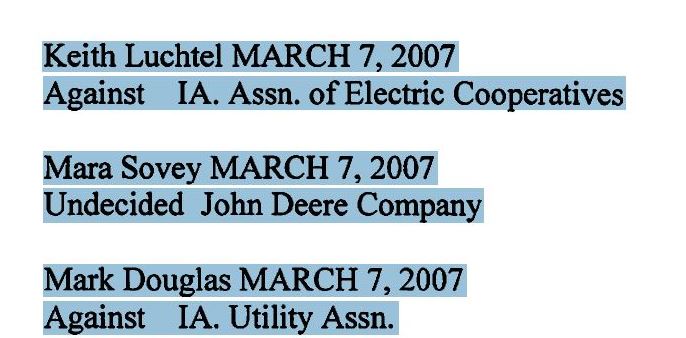
Alliant energy was predictably against this . Iowa Utilities Board stayed undecided, even though they regulate this area. Maybe they didn't want to anger the utilities, because something like this might happen. If I remember correctly, Ms Conrad was married to a MidAmerican employee, which always struck me as a potential conflict when relaying IUB positions to legislators.

  
Iowa Farm Bureau couldn't decide if they liked the idea of farmer owned wind projects. Farmers weren't getting a fair price for selling electricity from wind projects . This bill was a step in the right direction to address that,. School administrators evidently didn't see potential for more property tax money. Maybe farmers would accurately report their wind projects valuations to county assessors.


MidAmerican hated this bill so much they created the questionable handout in the last post to pass out to legislators. 


The rural electric coops opposed it, though I'm guessing some of their members might have liked it. Yes, I'm an REC member, though I wasn't back in 2007. Iowa Utility Association took the "none shall Pass " position. 

The counties understood they might get more property taxes as a result. 


 The steel workers liked it. Jobs you know. 


 State IBEW opposed their steel worker brothers and sisters. In fact,  IBEW members showed up at a Democrat controlled committee meeting to voices concerns, before eventually registering against the bill. 


and... clipper undecided , and ag business undecided . 

So, there were many "on the fence groups", along with hard opposition from the utilities and IBEW. 

So, obviously this bill didn't get voted on. Democrat floor leader Gronstal, even though he was a cosponsor, pulled this renewable energy bill, with 30 other cosponsors, from the vote calendar, and reassigned it to a sub committee chaired by Iowa climate change hawk, Democrat Senator Rob Hogg (also a bill sponsor), who let the bill expire without a hearing. 

So there you have it ,another example of the immense influence the utility lobby wields at the Iowa legislature. I suppose this will piss off some people that I know in Des Moines, but I think besides serving as another example of too much influence by powerful utility lobby interests, it should also serve as a cautionary tale for anyone who thinks that  the energy policy world will be right again if Democrats regain control of the state legislature. In this case, the Democrat controlled legislature and governors office couldn't pass a rural economic development bill  that would have built renewable energy. 

I don't really get partisan on the blog,  so this is strictly about how, IMO, utility power needs reined in. Doubters might  need some additional examples , like the identical bills prepared in the Democrat Senate, and Republican house for MidAmerican's planned nuclear plant a few years back. The Fukushima melt down happened while the bill was under consideration. otherwise, I'm confident that MEC would have built a nuclear plant that IMO would have stood an excellent chance of being an unneeded stranded asset for the utilities rate payers to pay off. I've heard some whoppers about the  year 2000 utility deregulation bill as well. From my view point, the utility lobby usually gets what it wants, regardless of which party is in control of the state house.

This is a monopoly problem, and Iowan's are facing monopoly problems in a number of areas, as Austin Frerick has been pointing out. 

  More to come ...             


here


Friday, June 22, 2018

Does Midamerican Have Too Much Influence On Regulators and Elected officials ?


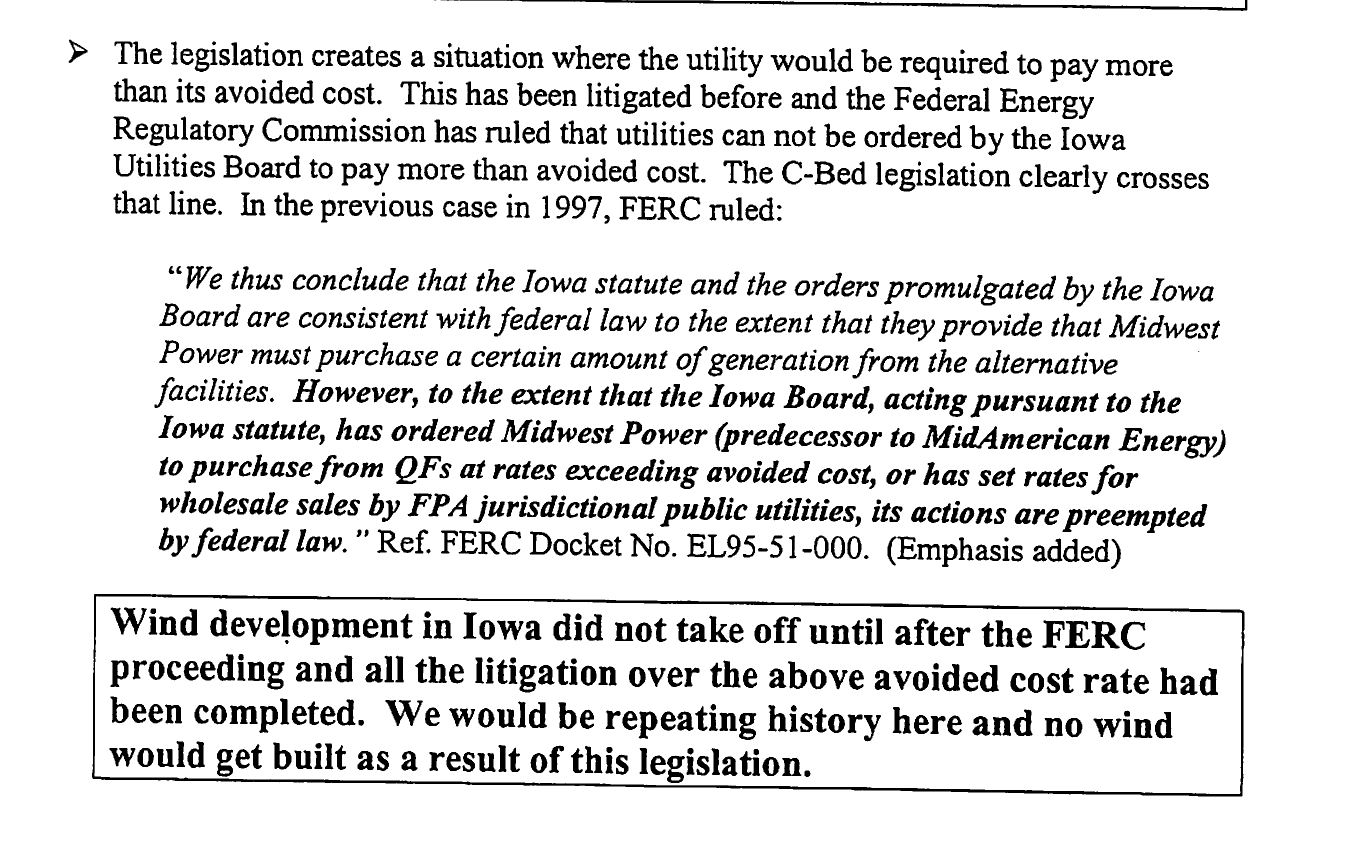
Another example of why I believe that MEC has too much influence on regulators and elected officials is their legislative handout (below) in opposition to legislation designed to encourage locally owned renewable energy. This happened  several years ago, but once again, this is yet another example where MEC estimates the cost of installing wind energy to be higher than the valuations they were actually reporting to county assessors.

 First lets examine the handout.  This Legislation that MEC opposed attempted to established a fair price for non utility owned (hopefully locally owned) wind energy by front loading the price paid by the utility to the wind project owner. The first 10 years, the price would be higher, then after the project had theoretically retired its debt, it would be receive a lower price for electricity sales by the utility. The CBED brochure below has more details. This is essentially a modified form of a feed in tariff IMO. It addressed the main problem with farmers, regular Iowans, etc run into when financing wind projects, that the avoided cost calculations used by utilities are unfair to independent wind project owners. This problem has been around since wind energy was first connected to the grid in the U.S. It's been written about extensively, to the point of ad nauseam, So I'm not seeing a reason to get into the weeds here.. IMO, this issue really comes down to utilities having too much influence on regulators and legislators  It's unnecessary to have electric provider monopolies when  anyone can generate their own electricity. It's time to come up with a fair way for people who want to do that to get paid for their electricity sales. Using the Utilities avoided cost calculations ( an average of  the cost of electricity for all the utility forms of generation)  isn't fair. 
Back to the legislation. This effort was patterned after similar similar legislation in Minnesota that was having good success at the time (more on this legislation in a future post). See the C- BED brochure at the bottom. That success was probably responsible for the MidAmerican freakout evident in their handout to legislators below. They obviously didn't want farmers- regular Iowans crossing the monopoly moat so favored by Warren Buffet.


 That their talking points below were successful should be ample evidence the utility has a little too much influence at the legislature IMO. To me , this handout misleads legislators on how the utility is compensated for their wind energy assets and threatens to litigate the legislation if it passes, as the utility did with net metering legislation before. They lost that one if I remember correctly. 


First of all, MEC is laughingly implying that they are compensated at their system wide avoided cost for wind energy, instead of the cost of building the wind facilities. But, as you can see from the IUB filing below, that doesn't seem to be the case. MEC is moving wind assets into the rate base, where they receive a guaranteed rate of return, as noted in their CBED calculations below. So, definitely not avoided cost. Good luck getting MEC and the IUB to tell you what that rate actually is. That this tactic was successful with legislators was disappointing.

     
Back then, MEC would respond to questions from me, so I asked them how they came up with their assumptions for this legislative hand out. Dean Crist from MEC was kind enough to provide them.


Note the MEC estimate of their guaranteed rate of return. But, also note that MEC estimates the installed cost of wind is much higher than they were  reporting to county assessors in the 2007 time period. 


I don't think the Minnesota legislation lasted more than a few years, I think the combination of utility opposition  and developers who weren't really "local" ended this effort, but, the Minnesota advocates probably know this story better.. A decade after this,  the avoided cost issue is still debated. Getting a fair price for electricity sales is definitely easier when the utility agrees, rather than when MEC picked a fight with the 30 some co sponsors of this Iowa effort (more on that in an upcoming post). It's pretty obvious that the value of renewable energy assets is higher than a utility's avoided cost. I just wonder how much longer it will take regulators and legislators to summon the courage to address that.

And then there's that wind property tax issue again! 


here

Tuesday, May 22, 2018

Does Midamerican Have Too Much Influence On Regulators and Elected officials ? updated 6-11-18


In my opinion... yes.
I'm going to shift gears slightly from the recent series of posts on the utility's wind asset valuations, and provide some examples of where I believe the utility gets its way too easily from the people responsible for utility over sight.

My first example though... once again... involves wind property taxes.
MEC is currently in the process of re-powering  a number of their wind projects in Iowa, with new longer blades, generators, gear boxes, etc, even though some of these projects are only 10 years old.
The utility claims the changes will result in almost 30% more more annual electricity production. Hmm, will MEC increase the annual lease payment to landowners, since the turbines will generate more revenue?

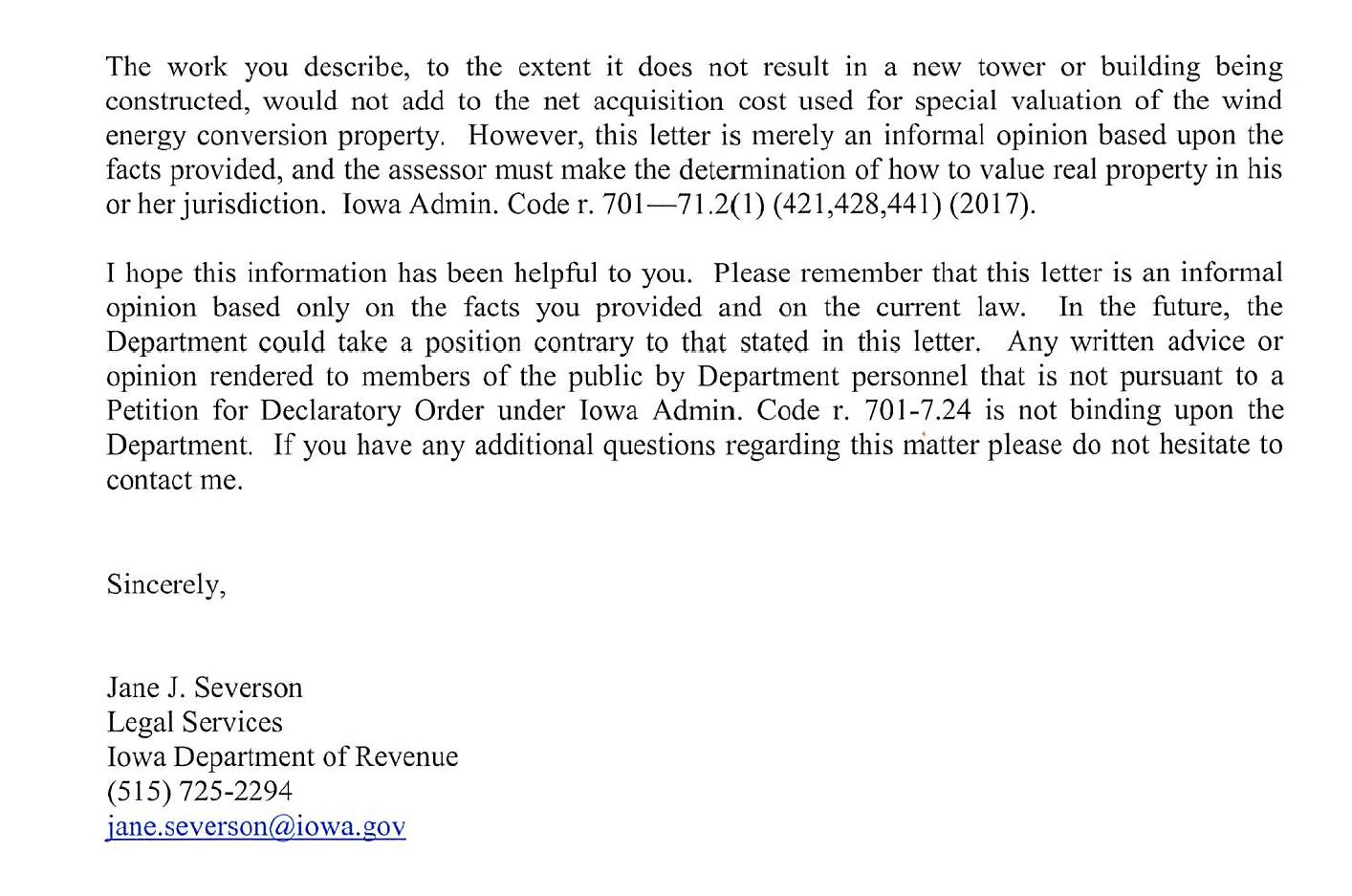
I attended the MEC permitting meeting in Pocahontas county for the re-power of the MEC Pomeroy Project. I inquired how the MEC wind turbine improvements would change the turbine valuations at this project. I was told that the valuations would remain the same, even though MEC is performing a major upgrade. County officials provided me with the following letter from the State Department of Revenue, as reason to leave turbine valuations unchanged.


So,  even though the DOR letter states that this is an an informal opinion, and treats the re-power as repairs, instead of the major upgrade that it appears to be, the county seems ready to agree, even though it isn't fair to the county bottom line IMO. I've already documented that the MEC Pomeroy project appears to be undervalued , when local assessor valuations are compared to the MEC's filings at FERC.  So, let's look at what's involved in MEC's planned re-power of these projects. 

MEC appears to be planning on claiming the federal production tax credit on the re-power, even though this project has already used the federal PTC once. I found an article that states in order for MEC to claim the federal PTC, 80% of each turbine has to replaced. 


These are not repairs. MEC is replacing nearly the entire turbine in order to generate more revenue, and claim a tax deduction. MEC doesn't appear to want to share the PTC with ratepayers. (PDF file) The IUB filing  states the re-power won't be done unless MEC keeps the PTC themselves. Since the re-power is proceeding , I'm guessing MEC got its way. Interesting to see the heavy hitters opposed to the re-power here though. So, do you think the utility has too much influence on regulators here?  

This sure has the look of a tax shelter, and if you search the www for "Warren Buffet tax avoidance", you'll find lot's of entertaining reading.  

Then there is this one, where Mr. Buffet claims utilities are only facing competition because of the federal tax credits,for renewables. Really... Berkshire shareholders are buying that one? 


This seems to be why Warren appears to like monopolies so much, MEC's competitors are shut out , as this now disappeared article notes . Hmm, maybe I can find a copy on the internet wayback machine. 


So, does this state sanctioned monopoly have too much influence in Iowa? 

 
UPDATE

I've found some additional information on the MEC wind turbine re power. The letter above provided by Pocahontas county was the basis for the county's opinion that property taxes would remain unchanged after the re power.


The dept of revenue opinion seems vague here. Does the "tower" refer to the entire wind turbine? What about the "building" ? There would normally be a building at the interconnection point. Maybe DOR means the nacelle when referencing "building".  If the letter means the actual tower sections , Surely DOR understands the tower sections are probably the least expensive part of the turbine. MidAmerican is replacing the nacelle, blades,and hubs, almost everything except the tower sections and concrete pad with an upgrade to a larger capacity nacelle,longer blades, and supporting equipment. These are essentially new, larger turbines and should be taxed accordingly IMO. DOR mentions this is only an informal opinion, however. 

I find it hard to believe that it's necessary to do this re power given the extra costs involved. I think it's risky to MidAmerican ratepayers. This Utilities Board filing by environmental law and policy center, and the Iowa environmental council (disclosure, I used to serve on the IEC board of directors), supports the re power, noting it will extend the useful life of the wind turbines another 20 years.. I'll bet that MEC pitched the extended turbine life in IUB filings as well. However some of the wind turbines slated for re powering are less than 10 years old.


 I found a 2013 IUB filing by MEC stating wind turbines have a useful life of 30 years or even longer, using letters from Siemens and GE stating properly maintained wind turbines have at least a 30 year useful life.. So... the re power only gets the  re powered turbines to the original 30 year lifespan? This begs the question - Is MEC not properly maintaining their wind projects?  :) I just couldn't resist! However, it raises a more serious question , I do wonder if there is a public record of regulators ensuring the proper maintenance of MidAmerican wind turbines.


    So, this seems like an unnecessary endeavor. Local government won't get treated fairly on property taxes IMO. There could additional risk for MEC ratepayers. Yet County officials, the state DOR, IUB and others, have, or seem ready to approve of this. But then, I noted this example of what can happen when a regulator gets on the wrong side of MidAmerican.     

Do you think MidAmerican has too much influence over regulators and elected officials? I do.     

      
here